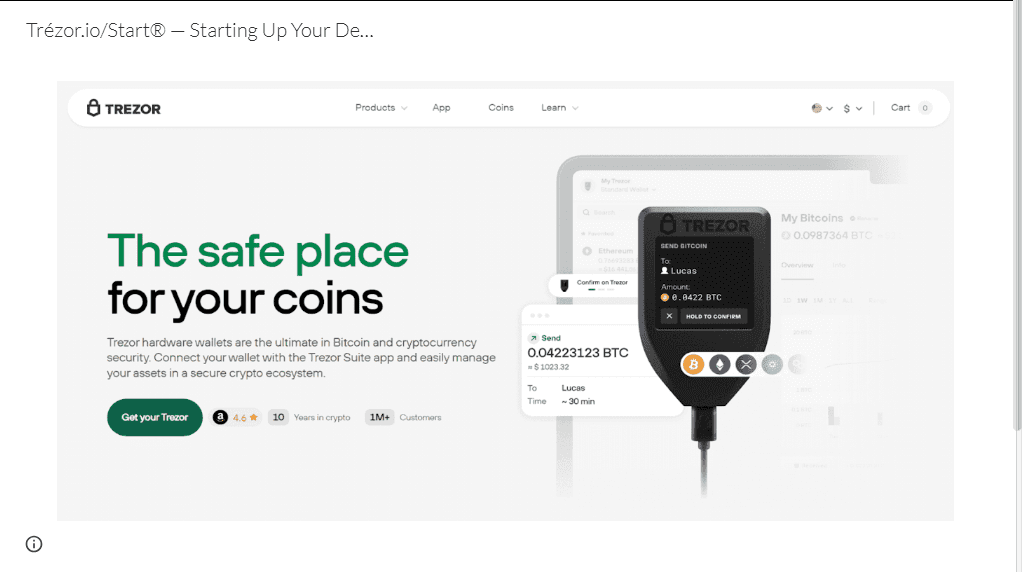
Trezor.io/start: The Intelligent Gateway to Self-Custody
In the rapidly evolving digital asset ecosystem, ownership is defined not by accounts or usernames, but by cryptographic keys. Trezor.io/start functions as the foundational entry point into this paradigm, guiding users through a carefully engineered onboarding process that transforms technical complexity into an intuitive, secure, and scalable experience. More than a setup page, it represents a philosophy of sovereign finance, where individuals retain absolute control over their wealth.
Why Trezor.io/start Matters
The primary challenge in cryptocurrency adoption is not purchasing assets, but safeguarding them. Centralized exchanges, while convenient, introduce counterparty risk. Trezor.io/start mitigates this by enabling users to initialize a hardware wallet that stores private keys in an isolated, tamper resistant environment. This separation between signing devices and internet connected systems forms the cornerstone of modern digital security.
By standardizing the initialization journey, Trezor.io/start reduces user error, a historically significant vulnerability in self custody. Its structured workflow ensures that even beginners can configure advanced security mechanisms without prior technical expertise.
The Setup Journey, Step by Step
The platform orchestrates the configuration process through a logical progression:
Device connection: Users link their Trezor hardware wallet to a computer or mobile device via USB or Bluetooth.
Firmware verification: The system authenticates and installs the latest firmware, guaranteeing optimal security and performance.
Wallet creation: Users generate a new wallet within the Trezor ecosystem rather than importing preexisting keys.
Recovery seed generation: A critical 12 or 24 word phrase is created, serving as a universal backup for asset restoration.
PIN configuration: A customizable numerical code adds a secondary authentication layer.
Each stage is designed with precision, minimizing friction while maximizing protection.
The Security Architecture Behind the Interface
Trezor operates on a deterministic wallet framework based on industry standards such as BIP39 and BIP32. These protocols enable hierarchical key derivation, meaning users can manage multiple blockchain addresses from a single recovery seed. Some Trezor models also support Shamir Backup, an advanced cryptographic method that splits recovery data into multiple fragments, adding redundancy and resilience.
Crucially, private keys never leave the device. Transaction signing occurs within the hardware wallet, ensuring that malware or phishing attacks cannot intercept sensitive credentials.
Best Practices for Users
To fully leverage Trezor.io/start, users should adopt disciplined security habits:
Store recovery phrases offline in multiple secure locations.
Avoid digital screenshots or cloud backups of sensitive data.
Regularly update firmware through official channels.
Use strong, unique PIN codes.
Pair Trezor with Trezor Suite for portfolio management and transaction analytics.
Beyond Setup
Once initialized, Trezor integrates seamlessly with decentralized finance platforms, NFT marketplaces, and multi chain ecosystems. Users can securely interact with Web3 applications, manage diverse digital assets, and monitor portfolio performance through an elegant, unified interface.
Conclusion
Trezor.io/start is not merely a configuration page, but a strategic gateway into the future of digital ownership. By blending cutting edge cryptography with user centric design, it empowers individuals to navigate the blockchain economy with confidence, autonomy, and uncompromising security. In an era where data and assets are increasingly vulnerable, Trezor establishes a gold standard for trust, transparency, and technological excellence.